
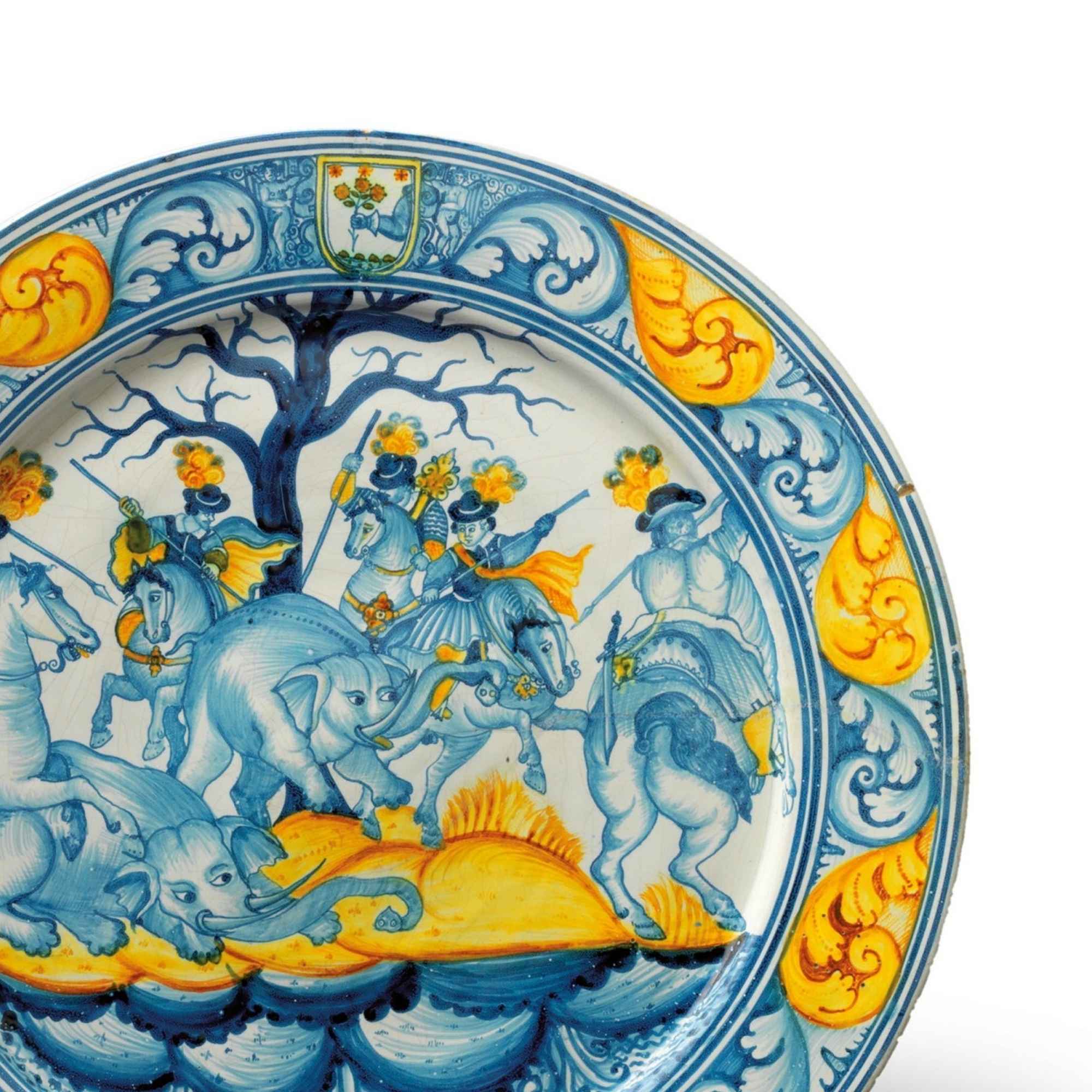
From the mid-18th century onwards, Laterza ceramics underwent a significant transformation, which was clearly reflected in the colour palette. The progressive affirmation of the so-called warm-toned palette —characterized by the use of yellows, oranges, and greens—does not only represent an aesthetic change, but is the result of a combination of economic, technological, and cultural factors that profoundly impact the entire majolica production system.
To understand this evolution, it is necessary to go beyond a purely stylistic reading and analyze the broader context in which it developed.
The decline of majolica in the 18th century
During the eighteenth century, Italian majolica, particularly that of southern Italy, gradually entered a period of difficulty. This phenomenon was not limited to Laterza, but involved many of the peninsula's production centers.
The main causes include:
- changing tastes of clients
- increasing competition from new materials
- increasing costs of raw materials
- reduction in demand for traditional decorative objects
Ceramic production, which in previous centuries had reached high levels of artistic quality, found itself having to face a changing market.
The impact of Chinese porcelain on the European market
One of the most relevant factors of this transformation is represented by the diffusion of Chinese porcelain in Europe.
As early as the 17th century, but with greater intensity in the 18th, the trade routes managed by the East India Companies – particularly the Dutch and English ones – favored the massive importation of porcelain from China.
These artefacts have completely different characteristics compared to European majolica:
- harder and more compact surface
- greater resistance
- coating gloss
- precise and refined decorations
From an aesthetic point of view, porcelain introduces a new quality standard, which changes consumer expectations.
But the most significant aspect is economic: thanks to large-scale production and established trade routes, Chinese porcelains gradually became accessible even to a non-aristocratic clientele.
This radically changes the market.
Majolica, which until then had been a high-quality product, suddenly found itself competing with a material perceived as more modern, more resistant, and often more elegant.
The European reaction: the birth of Western porcelain
The diffusion of Chinese porcelain also stimulated the birth of European productions, such as those of Meissen in Germany (early 18th century) and, subsequently, of other centres in France and Italy.
These new productions further contribute to reducing the space occupied by majolica in the high-end market.
Consequentially:
- majolica loses part of its centrality
- moves towards more accessible production
- it suits a less demanding clientele
The cost of cobalt and the problem of pigments
Another determining factor is the cost of raw materials, in particular the cobalt oxide used to obtain the blue.
Cobalt is not a locally available material in the Apulian region. The main historical sources were found in:
- Central Europe (especially Saxon and Bohemian areas)
- mining regions of Germany
- some areas of Eastern Europe
The importation of this material involved:
- high costs
- dependence on external commercial networks
- supply difficulties
👉 Blue, therefore, is not just a color: it is an expensive material.
At the height of the development of the blue monochrome, this cost was sustainable thanks to the presence of a clientele willing to pay for high-quality products.
But in the eighteenth century, with the changes in the market, this condition disappeared.
The need to reduce costs
With declining demand for high-end products and increasing competition from porcelain, ceramic workshops must adapt.
One of the most immediate strategies is to reduce production costs.
This involves:
- reduced use of expensive pigments
- simplification of decorations
- greater speed of execution
In this context, the use of cobalt blue tends to decrease, leaving room for cheaper and more easily available pigments.
From quality to simplification: the chromatic shift and the beginning of the transformation in the 18th century
The emergence of the warm-toned palette during the 18th century not only represents a chromatic evolution, but also signals a more profound shift affecting the entire Laterza ceramic production system. The colors that characterize this phase—yellow, orange, and green—are derived from more accessible oxides than the expensive cobalt used for blue. In particular, iron oxides allow for yellow and orange hues, while copper oxides are used for greens. These materials, cheaper and more readily available, respond to a real need for cost reduction in a context where demand for high-quality artifacts is progressively declining.
It's important to clarify that the term "poorer" does not indicate inferior quality in a technical sense, but rather a lesser economic value of the raw materials used. However, the transition to these pigments was part of a broader transformation: ceramic production was no longer primarily intended for aristocratic or highly demanding clients, but was geared toward a broader market, with varying demands in terms of cost, speed of production, and function.
From the mid-eighteenth century onwards, a progressive modification of the colour palette can be observed: the decorations become more vibrant, more contrasting, and more immediate, while blue loses the dominant role it had held in the previous century. This evolution occurs gradually, through an intermediate phase in which blue continues to be present, but is accompanied by new colours.
The consequences of this shift are also reflected in the decorative language. While the monochromatic blue required a high degree of control of the line, a refined ability to modulate color, and a careful construction of chiaroscuro, the polychromic warm-toned style tends to simplify compositions, favoring visual immediacy over narrative complexity. Decorations become less complex, more schematic, and in some cases more repetitive.
This transition should not be interpreted solely as a decline, but rather as an adaptation to new economic and production conditions. However, it marks the beginning of a phase in which Laterza ceramics gradually lost some of the technical and compositional refinement that had characterized its 17th-century heyday. In this sense, the chromatic shift also becomes a historical indicator: not only of an aesthetic transformation, but of the beginning of a slow decline in the overall quality of production, linked to the changing structure of demand and the market.