
Grottega: Innovation in Laterza Ceramics
by Roberto Lacarbonara
There Laterza ceramics It represents one of the most recognizable expressions of the Apulian tradition, with a history spanning centuries of artistic and artisanal production. From majolica destined for European courts to contemporary reinterpretations, this heritage continues to evolve.
In this in-depth study, Professor Roberto Lacarbonara analyzes the relationship between past and present through the experience of Grottega, highlighting how tradition can transform into contemporary language without losing its identity.
The value of the past in Laterza ceramics
Does the past have an expiration date? – he asks Georgi Gospodinov in his “Cronorifugio”. Then he added: “we are factories of the past”.
From the cave of a grotto in the ancient district of Mesola, in the small municipality of Laterza on the border between Matera and the Taranto, emanates a “solid” echo, generated by the plastic forms and the enamelled colours of the Laertina ceramics which finds its origin here and an unsuspected capacity for regeneration.
From tradition to international diffusion
The case of the little and very young girl Grottega, laboratory And atelier dedicated to contemporary pottery production, it represents an example of virtuous reinvention of those codes, techniques, styles and grammars of a past that has never ceased to project its energy.
The ancients traveled to every continent glazed majolica of blue and milky white produced in these lands, when the artisans of Laterza, which supplied between 1600 and 1700 Bourbons And Vatican, told the world about their extraordinary skills in shaping and decorating. They were albarelli intended for pharmacies and apothecaries; they were cups, amphorae and cake stands; and they were "narrative" objects, historiated or allegorical, living signs of an era and a culture.
Overcoming Nostalgia: A New Vision of Craftsmanship
In the rooms of Grottega, however, there is no place for the nostalgic contemplation of that "small ancient world" made of lost trades and disappeared workshops, that inert approach which so often leads to the sterile replication of decadent models or to a kitsch aesthetic oriented towards the tourist market. Dominique Parisi, the girls and boys of the group are heirs and interpreters of a renewed vitalism of practice: a form of fierce resistance that resurfaces from the past to become part of the new professions of the sculpture and of the decoration, from the jewelry store and of the design, from the fashion and of the’furniture, addressing the new challenges of the market and internationalization.
Technique, experimentation and cultural continuity
Every visit to the little one Grottega experimental center – I write as I return to it today, months after previous forays – is revealing of that incessant work rhythm that relaunches and rewrites, that invents and dares. unique pieces, embellished with third-fire lustres in gold, silver, platinum And copper, they look to tradition Ionic And Magna Graecia, reverberate the stylised signs of vase painting and the precious amenities of the gold of Taranto. The annular amphorae of derivation Roman, once used by pilgrims as containers for transporting water, come back to life in the so-called “our” time: but then, is there a time that is ours without belonging to every millennium already passed?
A model of cultural and economic development
That's how the Grottega model marks the step of a cultural transformation, centered on a different idea of product and of value, capable of monetizing the immense heritage of the thousand-year-old regional manufacturing and support the economic growth of an entire territory, its identity, his memory, its orientation towards the future.
Prof. Roberto Lacarbonara
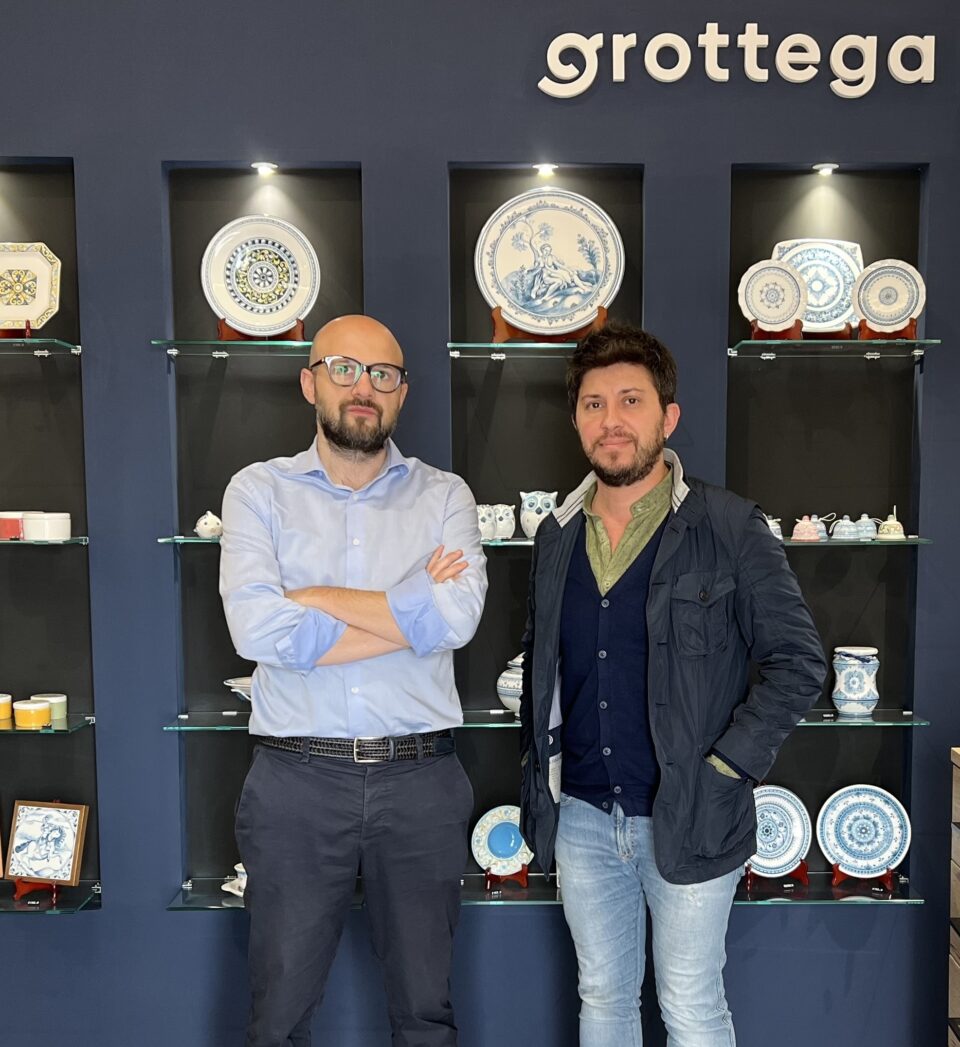
The case study highlights how Laterza's ceramics are not merely a historical testimony, but a still-active cultural system. Its continuity depends not on the passive preservation of past forms, but on the ability to reinterpret them in relation to contemporary languages and market dynamics.
In this sense, the value of tradition lies not in repetition, but in transformation: a process that allows a local heritage to maintain relevance even in broader contexts, without losing coherence and identity.